PTA Hardfacing vs Laser Cladding: How to Choose
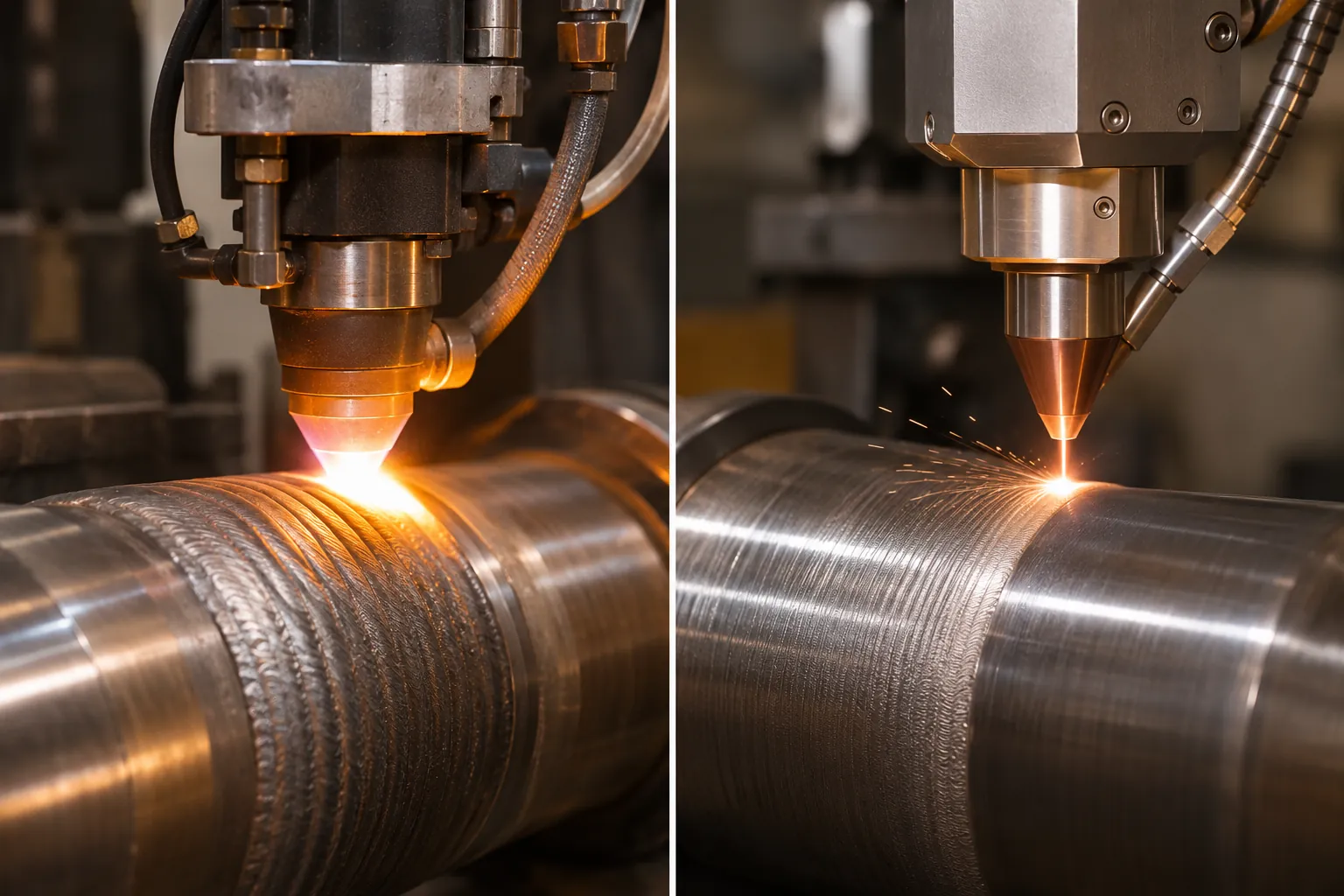
PTA (plasma transferred arc) hardfacing and laser cladding both fuse a metal or carbide layer onto a part. Both create a metallurgical bond, far stronger than a sprayed coating. The difference is in heat, thickness, precision and cost.
How they work
PTA melts powder in a constricted plasma arc and deposits it as a weld bead. Laser cladding uses a focused laser beam to melt a small pool on the surface while powder or wire is fed in.
| PTA hardfacing | Laser cladding | |
|---|---|---|
| Heat input | Moderate | Very low |
| Dilution with base metal | Low | Very low |
| Typical layer thickness | Thicker layers, often several mm | Thinner, precise layers |
| Distortion | Low to moderate | Minimal |
| Surface finish | Needs more machining | Smooth, near net shape |
| Cost per part | Lower | Higher |
Choose PTA when
- Wear is severe and you need a thick overlay
- Parts are large or heavy: rolls, plates, liners, elbows
- You want high carbide content for abrasion
- Cost per part matters
Choose laser cladding when
- The part is heat-sensitive or thin-walled
- Distortion must be kept to a minimum
- You need a precise layer with little machining afterwards
- The base material is hard to weld conventionally
Bottom line
Both are excellent for the right job. For heavy wear on big parts, PTA hardfacing usually wins on cost and thickness. For precision parts, laser cladding is hard to beat. Tell us about your part and we will recommend one.